Neurofeedback in Los Angeles & Pasadena
Clients struggling with anxiety, depression, ADHD, and more can find relief through the use of neurofeedback. At Vital Brain Health, we utilize neurofeedback to help our clients understand their brain waves with real-time feedback. With this therapy, we can help clients learn self-regulation to improve their function and live without the struggles their condition causes.
This may include support for adult ADHD symptom management, pediatric attention deficit support, non-medication sleep improvement, childhood OCD therapeutic interventions, and managing disruptive behavioral challenges.
Schedule an appointment with Vital Brain Health for neurofeedback. Our team is dedicated to helping you find relief from even the conditions that try to hold you back in life.
Get StartedAt a Glance
Neurofeedback is a drug-free, non-invasive brain training. At Vital Brain Health in Los Angeles and Pasadena, we map your brain with qEEG, then guide it with real-time feedback so the networks behind focus, calm, and sleep learn healthier patterns, no medication required. Available in-office and as remote programs nationwide.
What is Neurofeedback?
Neurofeedback is the evolution of brain optimization: a scientifically-validated method that harnesses your brain's natural neuroplasticity to improve how you focus, feel, and function. At Vital Brain Health we have pioneered Neurofeedback 3.0, an integrated multi-modal training approach that combines the best elements from all available methods and technologies.
Unlike traditional approaches that rely on a single method, Neurofeedback 3.0 is a comprehensive meta-strategy that combines multiple analysis methods, including AI-based analysis, network connectivity assessment, normative database comparisons, and symptom tracking, to build a complete picture of each client's unique brain patterns. We then select from over 20 neurofeedback techniques to design a truly personalized protocol.
To picture it, imagine your brain as an elegant 19-room mansion. Each room specializes in a different function: your executive office for decision-making, a memory library, an attention control room, an emotional processing suite, and 15 other specialized areas. These rooms communicate through neural hallways and a 5-channel intercom system representing different brainwave frequencies. Neurofeedback teaches them to coordinate, so improvements in focus, calm, and sleep hold over time.
Conditions Neurofeedback Can Help Support
At Vital Brain, we believe in supporting your care with a comprehensive array of services to help you live a better life. People seek neurofeedback for a range of reasons. We support people who may be experiencing any of the following:
Depression
Neurofeedback can help clients create better brain activity to overcome depression using neurofeedback training and neuromodulation.
Anxiety
By utilizing neurofeedback, trainers can help children and adults calm their anxiety by providing insights into how they can train their brains to handle anxiety differently.
ADHD
Therapists providing neurofeedback and neurofeedback training can help clients with ADHD improve their focus and memory.
OCD
Neurofeedback is especially helpful for retraining the compulsions people with OCD experience.
Advantages of Neurofeedback With Vital Brain Health
Neurofeedback can help alleviate a variety of frustrations your condition may be causing. At Vital Brain Health, we work to provide comprehensive care to help you live life a little easier. Some of the advantages of neurofeedback include:

Long-Lasting
Successful cases of neurofeedback provide relief and support that lasts for incredibly long periods. In some instances, clients have even reported the benefits being indefinite.

Non-Invasive
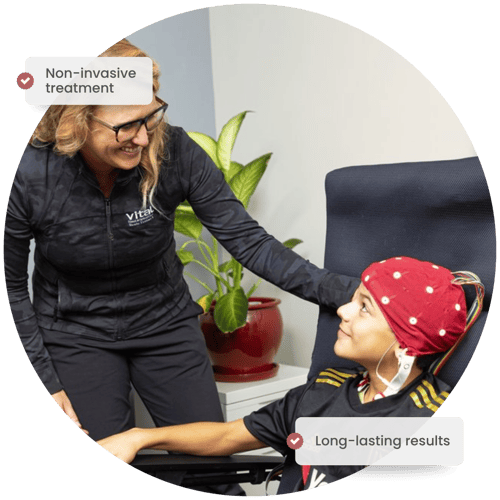
The process of neurofeedback is non-invasive, meaning clients do not have to worry about going through surgery in order to get the support they need.
Why Choose Vital Brain Health for Neurofeedback?
Vital Brain Health is dedicated to helping people overcome their limitations and improve their lives. We see each of our clients as a unique individual with a unique story, challenges, and aspirations. We utilize science-backed methods and a team of PhD scientific advisors to ensure that we always provide you with the best and most scientifically accurate support possible.
Are you ready to take control of your health? If you are, schedule an appointment with Vital Brain Health today. Our team can help you restore your wellness and feel your best.

Frequently Asked Questions
What is neurofeedback?
Neurofeedback is advanced brain training that helps optimize your brain's natural function through real-time feedback. Think of your brain as a sophisticated 19-room mansion where each room handles a different function: memory, attention, emotions, language. Neurofeedback teaches these rooms to communicate more effectively, resulting in improved focus, emotional regulation, and cognitive performance without medication.
How does neurofeedback work?
Neurofeedback works by helping your brain’s different "rooms" communicate more effectively through their shared frequency channels, like ensuring walkie-talkies are tuned to the same channel so they can work together. We use advanced EEG sensors to monitor how well your brain’s rooms are coordinating, then provide real-time visual feedback when they achieve optimal synchronization. As the rooms get rewarded for tuning to the same channel, they trigger new nerve connections that grow during sleep, allowing them to stay in tune longer and better the next time. This process harnesses neuroplasticity, your brain’s ability to rewire itself, creating lasting improvements in attention, emotional regulation, and cognitive performance.
What is a typical brain training neurofeedback session?
A typical Neurofeedback 3.0 session at Vital Brain Health lasts 15-30 minutes and offers a uniquely engaging experience. In our office, you'll relax in zero gravity chairs while your brain controls how clear your favorite shows appear on 70-inch TVs. For home training, you'll use our custom cap with gold-plated sensors connected to your phone or tablet. Our extremely effective forms of neurofeedback require shorter sessions than weaker training methods, maximizing your results in minimal time.
How is Vital Brain Health neurofeedback different from other neurofeedback practices?
Vital Brain Health stands apart as Los Angeles' premier evidence-based neurofeedback center through our Neurofeedback 3.0 approach, an integrated multi-modal training system that represents a comprehensive meta-strategy pulling from many forms of analysis and neurofeedback tools. While other practices use basic single-method training, we strategically combine multiple analysis methods including AI-based analysis, network connectivity assessment, normative database comparisons, and symptom tracking to create the most personalized and effective training for each individual. When standard treatments and budget neurofeedback options have failed, discerning families and individuals choose us for results-driven, scientifically-validated training.
References
Arns, Martijn, et al. "Neurofeedback and Attention-Deficit/Hyperactivity Disorder (ADHD) in Children: Rating the Evidence and Proposed Guidelines." Applied Psychophysiology and Biofeedback, vol. 45, no. 2, 2020, pp. 39-48.
Enriquez-Geppert, Stefanie, et al. "The Morphology of Midcingulate Cortex Predicts Frontal-Midline Theta Neurofeedback Success." Frontiers in Human Neuroscience, vol. 7, 2013, pp. 1-10.
Ros, Tomas, et al. "Consensus on the Reporting and Experimental Design of Clinical and Cognitive-Behavioural Neurofeedback Studies (CRED-nf Checklist)." Brain, vol. 143, no. 6, 2020, pp. 1674-1685.
Thibault, Robert T., et al. "Neurofeedback, Self-Regulation, and Brain Imaging: Clinical Science and Fad in the Development of a Neurotechnology." NeuroImage, vol. 76, 2013, pp. 120-129.
Sherlin, Leslie H., et al. "Neurofeedback and Basic Learning Theory: Implications for Research and Practice." Journal of Neurotherapy, vol. 15, no. 4, 2011, pp. 292-304.
Othmer, Siegfried, et al. "Implementation of Real-Time Digital Filtering in Neurofeedback." Journal of Neurotherapy, vol. 17, no. 1, 2013, pp. 5-18.
Kouijzer, Mirjam E. J., et al. "Long-Term Effects of Neurofeedback Treatment in Autism." Research in Autism Spectrum Disorders, vol. 7, no. 4, 2013, pp. 496-501.
Micoulaud-Franchi, Jean-Arthur, et al. "Electroencephalographic Neurofeedback: Level of Evidence in Mental and Brain Disorders and Suggestions for Good Clinical Practice." Neurophysiologie Clinique, vol. 45, no. 6, 2015, pp. 423-433.
Escolano, Carlos, et al. "EEG-Based Upper-Alpha Neurofeedback Training Improves Working Memory Performance." Proceedings of the Annual International Conference of the IEEE Engineering in Medicine and Biology Society, 2014, pp. 2327-2330.
Marzbani, Hamed, et al. "Neurofeedback: A Comprehensive Review on System Design, Methodology and Clinical Applications." Basic and Clinical Neuroscience, vol. 7, no. 2, 2016, pp. 143-158.
Vernon, David J. "Can Neurofeedback Training Enhance Performance? An Evaluation of the Evidence with Implications for Future Research." Applied Psychology, vol. 54, no. 3, 2005, pp. 385-404.
Get the Neurofeedback You Need
Whether you're in the Los Angeles area or elsewhere in the United States, we can provide you the services you need.
Get Started
Reach Out To Us

Professional Certifications