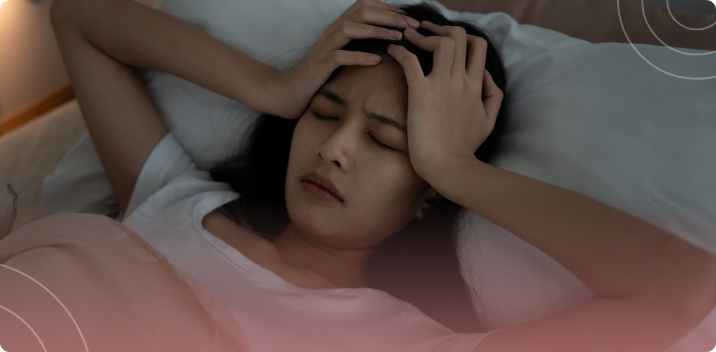
Chronic insomnia and disrupted sleep affect millions of adults, leaving them exhausted, foggy, and unable to perform at their best. About one in three adults in the United States does not get enough rest or sleep, and that shortfall is tied to everything from poor focus to heart disease. If you have tried sleep hygiene tweaks, melatonin, blackout curtains, and prescription medication without lasting relief, neurofeedback offers a medication-free approach that targets the root cause of poor sleep: dysregulated brainwave patterns. This guide explains how it works and what to expect.
Why Does Your Brain Keep You Awake at Night?
Your brain keeps you awake when its electrical activity stays locked in a state of high alert instead of winding down. Sleep is an active, coordinated brain process, not a passive shutdown, so when fast, alert brainwaves dominate at night, the transition into rest never fully happens.
To picture this, imagine your brain as an elegant 19-room mansion. The sleep control center has to communicate smoothly with the stress response room, the emotional processing chambers, and the attention networks for rest to arrive on schedule. According to the National Institute of Neurological Disorders and Stroke, structures including the hypothalamus, brainstem, and thalamus all interact to regulate when you sleep and when you wake.
In people with chronic insomnia, certain rooms stay on high alert long after the day is done. The stress response room may send overly loud signals even when there is no real threat, and the executive office may refuse to clock out, keeping thoughts racing. These breakdowns show up as measurable signatures on a qEEG brain map: excessive beta wave activity, the fast frequencies tied to alertness and stress, when the brain should be producing more of the slower alpha and theta waves that precede sleep. This lines up with the hyperarousal model of insomnia, the idea that an over-activated brain keeps the sleep system switched on. When the pattern persists three or more nights a week for longer than three months, it qualifies as chronic insomnia rather than an occasional rough night.
What Does Brain Mapping Reveal About Your Sleep?
Brain mapping reveals the specific brainwave dysregulation behind your sleep struggles, so training can be precise rather than generic. Before any training begins, a comprehensive 3D qEEG brain mapping session measures your brain's electrical activity and shows exactly which regions are overactive, which connections are weak, and which frequency bands need retraining.
This goes well beyond the colored pictures from a basic sleep study. A traditional sleep study mostly measures what happens while you sleep, while qEEG mapping shows how your brain regulates itself across many frequency bands during waking hours. Several patterns turn up again and again: excessive high-beta activity (25 to 30 Hz) persisting into the evening and fueling racing thoughts, poor connectivity between frontal regions and the brain's sleep centers, and irregular sensorimotor rhythm (SMR) activity, the 12 to 15 Hz frequency that acts as a gateway to sleep. The map turns guesswork into a personalized protocol.
How Does Neurofeedback Retrain Your Brain for Better Sleep?
Neurofeedback retrains your brain by giving it real-time rewards whenever it produces a healthier, sleep-ready pattern. Small sensors placed on the scalp read your brainwaves while you watch a video or listen to music, and the feedback responds the moment your brain reaches a calmer frequency, so it gradually learns to repeat that state on its own.
The sensors measure activity through electroencephalography (EEG). They do not send any signal into the brain; they only read what is already happening. Published reviews describe neurofeedback as a form of self-regulation training built on real-time brainwave feedback, and standard EEG interpretation, as outlined in this overview of normal EEG rhythms, describes how alpha, beta, and theta frequencies appear across different states of wakefulness and drowsiness.
For sleep specifically, one key target is the sensorimotor rhythm. Research on conditioning the 12 to 15 Hz sensorimotor rhythm has linked this kind of training to increased sleep spindle activity and a shorter time to fall asleep. We call our integrated approach Neurofeedback 3.0, a multi-modal brain training method that blends AI-based analysis, network connectivity assessment, normative database comparisons, and symptom tracking to build a complete picture of each person's brain, then selects from more than 20 different techniques to design a protocol matched to that individual profile rather than a one-size-fits-all script.
The research is encouraging while still maturing. A published review of neurofeedback for insomnia found that the studies examined consistently reported clear improvements in how well people felt they slept, with the most common approach training sensorimotor rhythm to ease sleep onset. Researchers also call for larger, more rigorous trials, which is why we frame brain training as a credible drug-free option rather than a guaranteed cure, and why we map first and tailor every plan.
What Happens During a Sleep-Focused Training Session?
A typical Neurofeedback 3.0 session lasts 15 to 30 minutes, with no needles, no medication, and no downtime. You relax in a zero-gravity chair while your brain activity controls how clearly your favorite shows appear on a large screen, so the training feels calming rather than clinical.
Everything starts with your brain map. Once it is analyzed, the clinical team reviews the findings with you in person or over a Zoom call, so you understand what is happening in your own brain and why the protocol is built the way it is. Most clients begin with a four-month program designed to improve both sleep quality and duration. Early improvements often appear within the first several sessions and may include falling asleep 15 to 20 minutes faster, waking less often during the night, or rising more refreshed. As training continues, these gains typically deepen and become more consistent. Because the brain is forming new connections through neuroplasticity rather than depending on a nightly pill, successful cases tend to hold, and some clients have reported benefits lasting for years.
Can Brain Training Pair With Other Drug-Free Tools?
Yes. Because insomnia rarely has a single cause, pairing neurofeedback with complementary drug-free tools often produces steadier results. The goal is always the same: help the nervous system downshift so sleep can take over naturally.
The most useful companion is biofeedback, which trains body-based signals such as breathing, heart rate, and muscle tension so you can switch off the stress response on demand. As the Mayo Clinic explanation of biofeedback describes, sensors monitor functions like breathing, heart rate, and muscle activity, then feed that back so you can learn to control responses that usually feel automatic. Research on heart rate variability biofeedback and sleep quality found that several weeks of slow-breathing biofeedback improved participants' reported sleep quality and boosted calming parasympathetic activity. Where neurofeedback works directly on brainwaves, biofeedback quiets the physical tension that keeps many people lying awake, which is especially helpful when a racing mind and a tense body feed each other at bedtime.
Is Neurofeedback a Safe Alternative to Sleeping Pills?
Neurofeedback can serve as a drug-free alternative for people who want to avoid the dependency risks and side effects of sleep medications. Rather than sedating the brain, it trains the nervous system to produce restful states on its own, addressing the neurological root of poor sleep instead of masking the symptom.
It is non-invasive, requires no surgery or prescriptions, and has no recovery time. That fits how leading clinicians actually approach the problem: they point to behavioral, non-drug strategies as the first-line approach for chronic insomnia before medication. Neurofeedback sits naturally within that philosophy and complements healthy habits like a consistent schedule and a calm bedroom. Decisions about any prescription should always be made with the doctor who prescribed it; many people begin training while still on medication, then discuss adjustments as their natural sleep improves.
Why Does Better Sleep Matter So Much?
Better sleep matters because rest is one of the brain's core maintenance windows, not an optional luxury. The Centers for Disease Control and Prevention notes that most adults need seven or more hours of quality sleep, and that consistently getting enough supports immune function, mood, heart health, and a lower risk of chronic disease.
When that window stays disrupted, the costs add up. The National Heart, Lung, and Blood Institute explains that chronic insomnia can impair memory and concentration and raise the risk of conditions such as high blood pressure and heart disease. Healthy sleep also moves through distinct stages, each with its own job. As the Sleep Foundation describes, a normal cycle runs from lighter non-REM stages into deep sleep and REM, repeating several times a night, with the deepest stage marked by slow delta waves that drive the most physically restorative rest. When the brain cannot settle into these stages cleanly, you can spend hours in bed and still wake unrefreshed, the frustrating hallmark of insomnia that brain training aims to resolve.
Can You Do Neurofeedback for Sleep Remotely?
Yes, remote training brings the same protocols into your home, which works especially well for sleep because you can train in the evening hours when you are naturally winding down. Nearly half of clients now train this way, and that share keeps growing.
Fully remote brain-training programs use the same clinic-grade hardware, software, and clinical oversight as in-office sessions, so the quality of the protocol stays consistent. Training at home can even strengthen results, because your nervous system learns to associate calmer states with the room where you actually sleep. Consistency is one of the biggest factors in retraining sleep patterns stuck for years, and skipping the commute makes a steady schedule easier to keep.
If you would like expert guidance, Vital Brain Health offers neurofeedback and personalized insomnia relief programs from its Pasadena office and through nationwide remote programs. The team of top-rated trainers works alongside PhD scientific advisors to keep each protocol grounded in current, accurate neuroscience. If chronic insomnia or disrupted sleep is interfering with your life, a brain map and an initial consultation are the first step toward reclaiming the rest your brain and body need.
Frequently Asked Questions
How long does neurofeedback take to improve sleep?
Many clients notice early changes within the first several sessions, such as falling asleep 15 to 20 minutes faster or waking less often during the night. Deeper, more consistent improvement usually develops over a four-month program as the brain builds and reinforces new patterns. Because every brain is different, your trainer tracks your progress against your initial brain map and adjusts the plan as you go.
Is neurofeedback safe and free of side effects?
Neurofeedback is non-invasive and does not send any signal into your brain. The scalp sensors only read the electrical activity that is already happening, so there is no surgery, no medication, and no recovery time. Most people find sessions deeply relaxing, and any brief tiredness after an early session tends to pass quickly.
Do I have to stop my sleep medication to try neurofeedback?
No. Neurofeedback can be done alongside your current routine, and decisions about any prescription should always be made with the doctor who prescribed it. Many clients begin training while still on medication, then discuss adjustments with their physician as their natural sleep improves over the course of the program.
How is neurofeedback different from biofeedback for sleep?
Neurofeedback trains brainwave activity directly, teaching the brain to produce calmer, sleep-ready patterns. Biofeedback trains body-based signals like breathing, heart rate, and muscle tension so you can quiet physical tension on demand. Many sleep clients benefit from both, since racing thoughts and a tense body often reinforce each other at bedtime.
How is qEEG brain mapping different from a regular sleep study?
A traditional sleep study mostly measures what happens while you are asleep, while qEEG brain mapping shows how your brain regulates itself across many frequency bands during waking hours. That detail reveals the specific dysregulation behind your sleep trouble, such as excess beta when slower waves should dominate, and becomes the blueprint for a personalized protocol.
Ready to take the next step?
Talk with the Vital Brain Health team about a Neurofeedback plan built around your brain and your goals.