
Neurofeedback for School Refusal in Los Angeles & Pasadena
Attending school is something every child struggles with a little bit. However, in some children, going to school becomes such a negative experience it leaves them feeling overwhelmed and has a detrimental effect on their emotional well-being. When these negative emotions become overwhelming, it is known as school refusal.
School refusal can leave a child struggling academically, socially, and with their emotional well-being. At Vital Brain Health, we help those seeking therapy for their child's school refusal through a comprehensive, holistic approach.
At a Glance
At Vital Brain Health, neurofeedback is a drug-free, non-invasive training that starts with qEEG brain mapping and uses real-time feedback to help the brain regions behind school refusal communicate better. By easing anxiety and improving emotional regulation, it helps children move past avoidance and return to school more comfortably.
What is School Refusal?
School refusal is a symptom of severe anxiety, depression, or trauma related to attending school. Learning disabilities, severe negative social interactions, and other extreme difficulties in school can cause school refusal in children that leads to other challenges.
At Vital Brain Health, we can help provide early intervention, giving your child the strategies they need to support their condition and overcome the behavioral challenges school refusal can cause.
Our staff are experienced, kind, and ready to help. Schedule an appointment for school refusal support today.
Common Risk Factors Associated With School Refusal
Understanding the common risk factors associated with school refusal in children can help you get your child the support they need. School refusal is often the result of one of a variety of risk factors:
Anxiety
Social and generalized anxiety can cause children to dread going to school, triggering school refusal.
Depression
Depression can cause a lack of interest in activities and leave people mentally and emotionally exhausted. This makes even something as routine as attending school a major challenge.
Trauma
Traumatic events and post-traumatic stress disorder (PTSD) can cause school refusal in children.
Learning Disabilities
Learning disabilities can place additional stress on children and make school a more challenging prospect. For children who don't get the support they need, it's common for them to develop school refusal.
Key takeaway
School refusal is often driven by anxiety, depression, or trauma. Our drug-free, qEEG-guided neurofeedback retrains the underlying brain patterns so your child can feel calmer about school and build lasting confidence.
What symptoms are associated with school refusal?
Because anxiety sits underneath so many cases of school refusal, our clinicians wrote a practical guide to whether neurofeedback helps a child with anxiety, and many parents find it a helpful first read before booking an evaluation.
If your teen's avoidance centers on tests and grades, we also break down why students freeze under pressure and how training helps, with steps families can take right away.
What are the Support Options for School Refusal?
Vital Brain Health offers different types of support, each serving a different purpose. Some of the support options you may be recommended include:
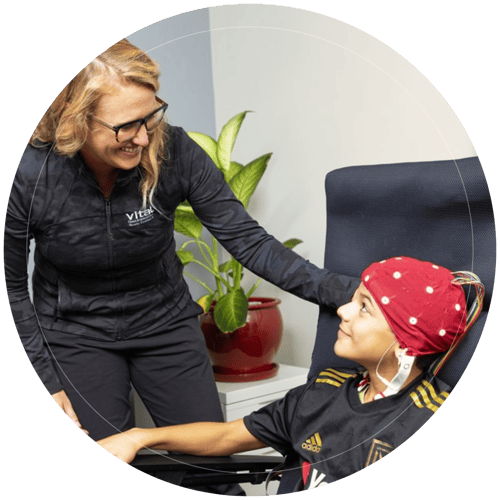
Neurofeedback
Neurofeedback utilizes advanced brain training to optimize your brain’s natural function using real-time feedback. This can help the different parts of your brain communicate more effectively, which in turn improves focus, emotional regulation, and cognitive performance. Best of all, no part of this process requires medication.
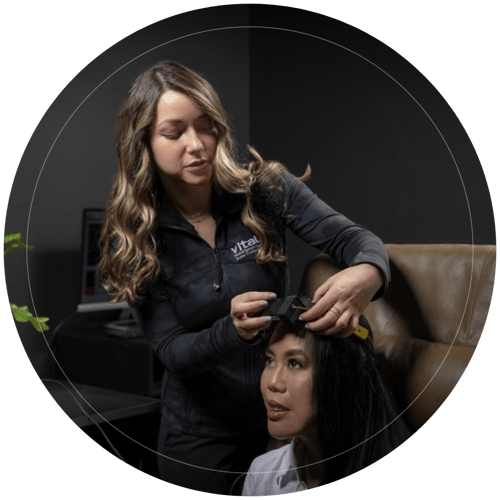
Biofeedback
Biofeedback provides strategies to help people control physical actions such as breathing and heart rate in order to combat conditions such as anxiety. This can help children with school refusal calm themselves and feel less overwhelmed emotionally at the idea of attending school.
Frequently Asked Questions
Yes, we provide advanced support for children with school refusal using Neurofeedback 3.0 integrated multi-modal training protocols specifically designed for children with school refusal. Our approach helps optimize brain networks to retrain behaviors associated with school refusal. We use research-based protocols that target the specific brain communication patterns underlying school refusal in children.
Our protocols for children with school refusal use Neurofeedback 3.0 to help the parts of the brain that cause children to reject and try to avoid attending school. Through our visual feedback system, we train brain areas to learn to coordinate on shared frequency channels, developing stronger connections during sleep that lead to improvements in helping children move past the avoidance behaviors they exhibit.
Neurofeedback represents the evolution of brain optimization, a scientifically-validated method that harnesses your brain's natural neuroplasticity to improve brain function. At Vital Brain Health, we've pioneered what we call Neurofeedback 3.0, representing an integrated multi-modal training approach that combines the best elements from all available methods and technologies.
Every child's training plan is individualized, so there is no one-size-fits-all number. Your child's plan starts with their qEEG brain map, and many training plans run in the range of 30 to 40 sessions spread over several months. The exact recommendation comes from the initial evaluation, where our team reviews your child's brain map and goals with you before any training begins.
Yes, neurofeedback is non-invasive and drug-free. Nothing enters your child's brain during a session: the sensors only read brain activity, and your child simply responds to visual and auditory feedback. Some children notice temporary tiredness after early sessions, similar to how the brain feels after learning something new, and this typically fades as training continues.
Yes. In addition to our Pasadena office, Vital Brain Health runs nationwide remote programs with home training equipment and clinician oversight. This can be especially helpful for a child whose anxiety makes leaving the house difficult, because training happens in the comfort of your own home while our team guides the process.
Enriquez-Geppert, Stefanie, et al. "The Morphology of Midcingulate Cortex Predicts Frontal-Midline Theta Neurofeedback Success." Frontiers in Human Neuroscience, vol. 7, 2013, pp. 1-10. Gruzelier, John H. "EEG-Neurofeedback for Optimising Performance. I: A Review of Cognitive and Affective Outcome in Healthy Participants." Neuroscience & Biobehavioral Reviews, vol. 44, 2014, pp. 124-141. Ros, Tomas, et al. "Consensus on the Reporting and Experimental Design of Clinical and Cognitive-Behavioural Neurofeedback Studies (CRED-nf Checklist)." Brain, vol. 143, no. 6, 2020, pp. 1674-1685. Micoulaud-Franchi, Jean-Arthur, et al. "Electroencephalographic Neurofeedback: Level of Evidence in Mental and Brain Disorders and Suggestions for Good Clinical Practice." Neurophysiologie Clinique, vol. 45, no. 6, 2015, pp. 423-433. Escolano, Carlos, et al. "EEG-Based Upper-Alpha Neurofeedback Training Improves Working Memory Performance." Proceedings of the Annual International Conference of the IEEE Engineering in Medicine and Biology Society, 2014, pp. 2327-2330. Vernon, David J. "Can Neurofeedback Training Enhance Performance? An Evaluation of the Evidence with Implications for Future Research." Applied Psychology, vol. 54, no. 3, 2005, pp. 385-404.

Get the Neurofeedback You Need
Whether you're in the Los Angeles area or elsewhere in the United States, we can provide you the services you need.

Reach Out To Us

Professional Certifications