If your child struggles with ADHD behaviors like impulsivity, difficulty with focus, or hyperactivity, you've probably explored multiple ways to provide support. Brain training has emerged as a promising medication-free approach, but one question consistently tops the list of parent concerns: how young is too young for neurofeedback training?
Most centers work with children as young as 5 or 6 years old, though some trainers may begin at age 4 if the child can sit relatively still for 20 to 30 minutes. In Pasadena, we've successfully supported children across all age ranges, with roughly half of our clients being children. The majority of our young clients fall between ages 7 and 14. ADHD is one of the most common conditions diagnosed in children, so it makes sense that families are looking for tools that build skills rather than mask symptoms.
How Young Is Too Young for Neurofeedback?
Most children are ready for neurofeedback training by age 5 or 6, and some as early as 4 if they can sit still for short stretches. Readiness matters more than the exact birthday: a child needs enough patience to watch a screen calmly while sensors read their brainwaves. Children 7 and older usually adapt fastest.
Unlike medication, which works regardless of cooperation, brain training requires active participation. The child must be able to sit comfortably, watch a screen, and remain relatively calm while sensors monitor their brainwave patterns. This doesn't mean your child needs to be perfectly behaved. It simply means they need enough ability to engage with exercises that feel like video games.
Children ages 7 and older typically have an easier time because their attention spans are longer and they better understand the idea of training their brain. Many families from Pasadena, Altadena, and surrounding Los Angeles areas report that their children actually enjoy the sessions once they realize they're playing games or watching their favorite shows while the training happens.
How Does Neurofeedback Training Work for Kids with ADHD?
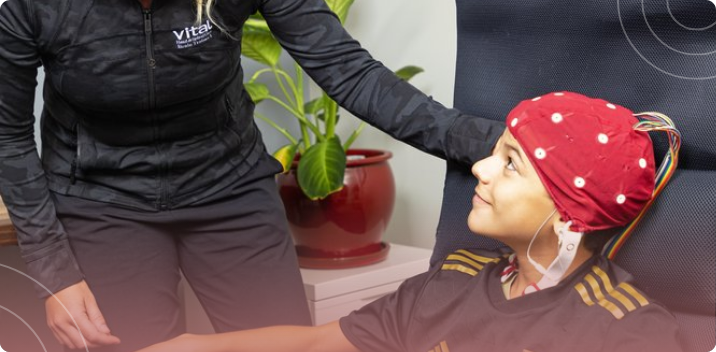
Neurofeedback translates your child's brainwave activity into feedback they can see and hear in real time. Small sensors on the scalp read EEG activity, and when the brain produces a more focused pattern, a game or video rewards it. Over many sessions, the brain learns to repeat that calmer, more attentive state on its own.
To picture it, imagine your brain as an elegant 19-room mansion. Each room specializes in a different mental function: your executive office for decision-making, a memory library for storing experiences, an attention control room for focus, and communication networks connecting all the rooms. In children with ADHD, certain rooms may not be communicating as efficiently as they could.
During a session, the sensors measure electrical activity using electroencephalography (EEG). These sensors don't send any signals into the brain. They only read what's already happening. As your child watches a video or plays a game, the game moves forward when their brain produces the desired pattern, and it slows or dims slightly when their brain slips into an unfocused state. This is the same operant-conditioning principle behind clinical biofeedback: real-time signals reinforce a desired response until the body learns to produce it independently.
That immediate feedback is what lets children learn to manage their own brain activity. The mechanism is well described in clinical literature on EEG biofeedback and brainwave patterns, where electrodes track the balance of slower and faster brainwaves and the system nudges the brain toward a more regulated mix. Through targeted exercises, we help your child's brain practice self-regulation. We've also pioneered Neurofeedback 3.0, an integrated multi-modal training approach that combines several analysis methods, including AI-based analysis, network connectivity assessment, and symptom tracking, and we select from over 20 techniques to design personalized protocols.
What Results Can Parents Expect?
Research suggests neurofeedback may help reduce core ADHD behaviors in children, though individual results vary. Reported improvements include steadier attention, better impulse control, lower hyperactivity, and stronger academic performance. We typically start clients on a four-month program built around improving one region of the brain or reaching one set goal.
Standard training protocols have been studied for decades. One published review of neurofeedback as a treatment intervention describes the most common approaches and notes that they have been considered efficacious for ADHD, while also calling for stronger clinical standards across the field. That balance of promise and caution is exactly why a personalized, supervised approach matters.
Most families begin to notice subtle changes within the first several sessions. These early signs might include your child completing homework with fewer reminders, sitting through dinner without excessive fidgeting, or following multi-step directions more consistently. Through visual feedback, these brain networks learn to communicate on more balanced frequency channels, developing new connections that lead to longer-lasting results. In some cases, families report that the benefits hold for very long periods.
Neurofeedback also works well alongside other brain health supports. We collaborate with your educational therapist, psychologist, psychiatrist, pediatrician, and tutor to maximize results, which fits the layered, age-appropriate approach to ADHD support in children that pediatric guidance recommends.
What Happens in a Session, and Can We Train From Home?
A typical Neurofeedback 3.0 session lasts 15 to 30 minutes. Our more efficient methods require shorter sessions than weaker training styles, so your child gets more out of less time in the chair.
In our office, your child relaxes in zero-gravity chairs while their brain controls how clearly their favorite shows appear on 70-inch TVs. We also offer remote neurofeedback programs so families can train from wherever they are in the country. Nearly half of our clients now receive remote training, and that number keeps growing. If you live an hour or more away, we can set up hybrid options like neurofeedback training at home.
Is Neurofeedback Training Right for Your Child?
Brain training may be a good fit if your child experiences side effects from ADHD medication, if you prefer to explore medication-free options first, if behavioral therapy alone hasn't provided enough support, if your child is at least 5 or 6 years old, if you can commit to a four-month program, or if you want an approach that teaches self-regulation skills your child can use for life.
Major health authorities describe a layered set of treatment options for ADHD that combine behavioral strategies, family involvement, and clinical support tailored to a child's age. Brain training fits naturally into that toolkit as a skill-building option, and many of our families combine neurofeedback in Los Angeles with the supports their child already has in place.
How Do We Personalize a Child's Brain Training Plan?
We start with a comprehensive intake assessment and a detailed brain map created with 3D qEEG brain mapping. That map gives you a blueprint of your child's brain "house" and shows how all the different rooms are functioning, so the protocol targets what your child actually needs.
We see each client as a unique individual with their own story, challenges, and aspirations. We use science-backed methods and a team of PhD scientific advisors to keep our work accurate and current. Brain training gives children a tool they can carry through life, helping them rebuild focus, self-control, and confidence in their ability to succeed.
Frequently Asked Questions
At what age can a child start neurofeedback for ADHD?
Most children can begin around age 5 or 6, and some start as early as 4 if they can sit still for short periods. Children 7 and older usually adapt the fastest because their attention spans are longer and they grasp the idea of training their brain.
Is neurofeedback safe for children?
Yes. The sensors only read the electrical activity the brain is already producing, and they do not send any signal into the brain. It is a noninvasive approach, which is one reason many parents explore it as a medication-free option.
How long before we see results?
Many families notice subtle changes within the first several sessions, such as finishing homework with fewer reminders or fidgeting less at dinner. A typical program runs about four months so the brain has time to build durable new patterns.
Will my child have to stop their ADHD medication?
No. Brain training is designed to work alongside your child's existing supports. We coordinate with your pediatrician, psychologist, tutor, and educational therapist rather than asking you to change any medical plan on your own.
Can we do neurofeedback from home?
Yes. We offer remote and hybrid programs so families who live an hour or more away, or anywhere in the country, can train from home. Nearly half of our clients already train remotely.
Ready to take the next step?
Talk with the Vital Brain Health team about a Neurofeedback plan built around your brain and your goals.