Millions of adults struggle with chronic insomnia and sleep disturbances that leave them exhausted, mentally foggy, and unable to perform at their best each day. Prescription sleep medications may offer short-term relief, but they rarely address the underlying neurological dysregulation that drives poor sleep in the first place. At our Pasadena office, our neurofeedback programs for better sleep are designed to retrain the brainwave patterns responsible for keeping you awake, helping your brain rediscover its natural capacity for deep, restorative rest.
Why Does Your Brain Struggle to Fall Asleep?
Your brain struggles to sleep when its electrical activity stays locked in a state of high alert instead of winding down. Sleep is an active, coordinated brain process, not a passive shutdown, so when fast, alert brainwaves dominate at night, the transition into rest never fully happens. This is the core pattern behind many cases of chronic difficulty falling and staying asleep.
Sleep requires precise, coordinated communication between multiple brain regions, each producing specific brainwave frequencies at the right times and in the right sequences. Federal neuroscience educators describe how distinct brain structures such as the hypothalamus and brainstem orchestrate the switch between wakefulness and sleep. When that orchestration breaks down, the result is the restless, racing, or interrupted sleep that defines insomnia.
Think of the brain as a 19-room mansion where every room serves a distinct purpose. The stress response room, the executive decision-making suite, the emotional processing chambers, and the sleep initiation center all need to communicate smoothly on balanced frequency channels for rest to occur naturally. In people with chronic insomnia, certain rooms remain on high alert long after the day is done, sending overactive signals that disrupt the descent into sleep.
This dysregulation shows up in measurable ways. Excessive beta wave activity, the fast-frequency brainwaves associated with alertness and stress, is a common finding in people who cannot fall asleep or stay asleep. When the brain produces too much beta and too little of the slower alpha and theta activity at night, the nervous system stays stuck in hyperarousal that no amount of counting sheep can overcome. Health authorities note that when this pattern persists three or more nights a week for over three months, it qualifies as chronic insomnia rather than an occasional rough night.
How Does Neurofeedback Address Dysregulated Sleep Patterns?
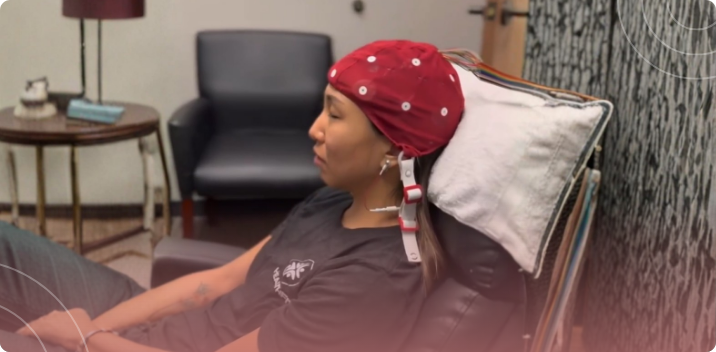
Neurofeedback addresses sleep problems by teaching the brain to self-regulate the very brainwave patterns that keep it awake. Small scalp sensors read your electrical activity in real time, and the system rewards calmer, sleep-friendly states with visual feedback, so the brain gradually learns how to settle itself without medication or willpower.
The sensors measure your brain's activity through a process called electroencephalography. They do not send any signals into the brain; they simply read the activity that is already occurring and translate it into feedback you can respond to. Published reviews describe neurofeedback as a form of self-regulation training built on real-time brainwave feedback, the same self-control principle that underlies broader biofeedback approaches for calming the nervous system.
During a session, as your brain begins producing the calmer, more balanced patterns associated with relaxation and healthy sleep preparation, the visual feedback rewards that shift. Over time, the brain learns to recognize what a sleep-ready state feels like and how to access it on its own. This is not a passive experience; it is an active learning process in which your brain builds new neural pathways that support lasting change.
At our practice, we have developed what we call Neurofeedback 3.0, an integrated multi-modal training approach that combines the most effective elements from every available method and technology. Rather than relying on a single technique, Neurofeedback 3.0 draws on AI-based analysis, network connectivity assessment, normative database comparisons, and ongoing symptom tracking to build a complete picture of each client's unique brain patterns. From that picture, our team selects from more than 20 different techniques to design protocols that are genuinely personalized to each individual's neurological profile.
What Does the Sleep Training Process Look Like?
The sleep training process starts with a detailed brain map, then moves into short, comfortable sessions tailored to your results. You first see exactly where your brainwaves are dysregulated, and from there our team builds a protocol that calms overactive frequencies and strengthens the patterns your brain needs for deep, uninterrupted sleep.
Before any brain training begins, every client receives a comprehensive 3D quantitative EEG brain map. This map serves as a blueprint of how the brain's networks are functioning, where dysregulation exists, and which frequencies need to be calmed or strengthened. Our clinical team reviews the brain map with each client in person or over a Zoom consultation, ensuring that you fully understand what is happening in your own brain and why our approach to retraining your sleep brainwaves is designed the way it is.
A standard Neurofeedback 3.0 session at our Pasadena office lasts between 15 and 30 minutes. Clients relax in zero-gravity chairs while their brain activity controls the clarity of their favorite shows displayed on 70-inch screens. The experience is comfortable, calming, and remarkably efficient because the precision of our multi-modal approach allows for shorter sessions without sacrificing results.
Most clients begin with a four-month training program designed to improve both sleep quality and sleep duration. Initial improvements often emerge within the first several sessions and may include falling asleep faster, waking less frequently during the night, and feeling more refreshed upon rising. As training progresses, these improvements typically deepen and become more consistent, with many clients reporting benefits that extend well beyond the conclusion of their program.
Is Neurofeedback an Alternative to Sleeping Pills?
Yes, neurofeedback can serve as a drug-free alternative for people who want to avoid the dependency risks and side effects of sleep medications. Rather than sedating the brain into unconsciousness, it trains the nervous system to produce restful states on its own, addressing the neurological root of poor sleep instead of masking the symptom.
For many adults, leading clinicians point to behavioral and non-drug strategies as the first-line approach for chronic insomnia before medication. Neurofeedback fits naturally within that philosophy. It requires no surgery, no prescriptions, and no recovery time, and it complements healthy sleep habits such as a consistent schedule and a calm bedroom environment that public health agencies recommend for supporting the body's natural sleep rhythm. Instead of working against your biology, the training works with it.
How Does Remote Neurofeedback for Sleep Work From Anywhere?
Remote neurofeedback lets clients complete brain training for sleep at home using clinic-grade hardware and software, guided by our team. Nearly half of our current clients train remotely, and evening sessions in the same room where you sleep can reinforce the calmer brainwave states your brain is learning to reach.
We offer fully remote programs for clients who live beyond a comfortable distance from our Pasadena office, and that number keeps growing as more people discover how accessible this approach can be. Remote sleep training carries a particular advantage: clients can complete sessions during the evening hours when they are naturally winding down for bed. Conducting brain training in Los Angeles or anywhere across the country within the environment where sleep actually occurs allows the nervous system to associate those calmer states directly with the context of home, reinforcing the progress made during each session.
At our practice, every client is seen as a unique individual with a distinct neurological story, specific challenges, and personal goals. Our team of top-rated trainers works alongside PhD scientific advisors to ensure that every protocol we design is grounded in current, accurate neuroscience. If chronic insomnia or disrupted sleep is interfering with your quality of life, brain training offers a path toward reclaiming the rest your brain and body need.
Frequently Asked Questions
How long does it take to see better sleep with neurofeedback?
Many clients notice early changes within the first several sessions, such as falling asleep a little faster or waking less often during the night. Deeper, more consistent improvement usually develops over a four-month program as the brain builds and reinforces new patterns. Because every brain is different, your trainer will track your progress against your initial brain map.
Is neurofeedback safe and does it have side effects?
Neurofeedback is non-invasive and the scalp sensors only read your brain's activity; they never send electricity or signals into the brain. It involves no surgery, no medication, and no recovery time. Most people find sessions deeply relaxing, and any temporary tiredness after a session typically passes quickly as the brain adjusts.
Do I need a 3D qEEG brain map before starting sleep training?
Yes. Every client begins with a comprehensive 3D quantitative EEG brain map that shows exactly where dysregulation exists and which frequencies need to be calmed or strengthened. This map becomes the blueprint for a personalized protocol, so your training targets your specific sleep patterns rather than a generic template.
Can neurofeedback replace my sleep medication?
Neurofeedback is a drug-free approach that addresses the neurological root of poor sleep rather than masking it, which is why many people use it to reduce reliance on sleep aids. It is not a substitute for medical advice, so never stop a prescription on your own. Talk with your prescribing clinician about how brain training can fit into your plan.
Does remote neurofeedback work as well as in-office sessions?
Remote programs use the same clinic-grade hardware, software, and clinical oversight as in-office training, so the quality of the protocol stays consistent. Training at home in the evening can even strengthen results, because your nervous system learns to associate calmer states with the room where you actually sleep. Nearly half of our clients now train remotely with strong results.
Ready to take the next step?
Talk with the Vital Brain Health team about a Neurofeedback plan built around your brain and your goals.