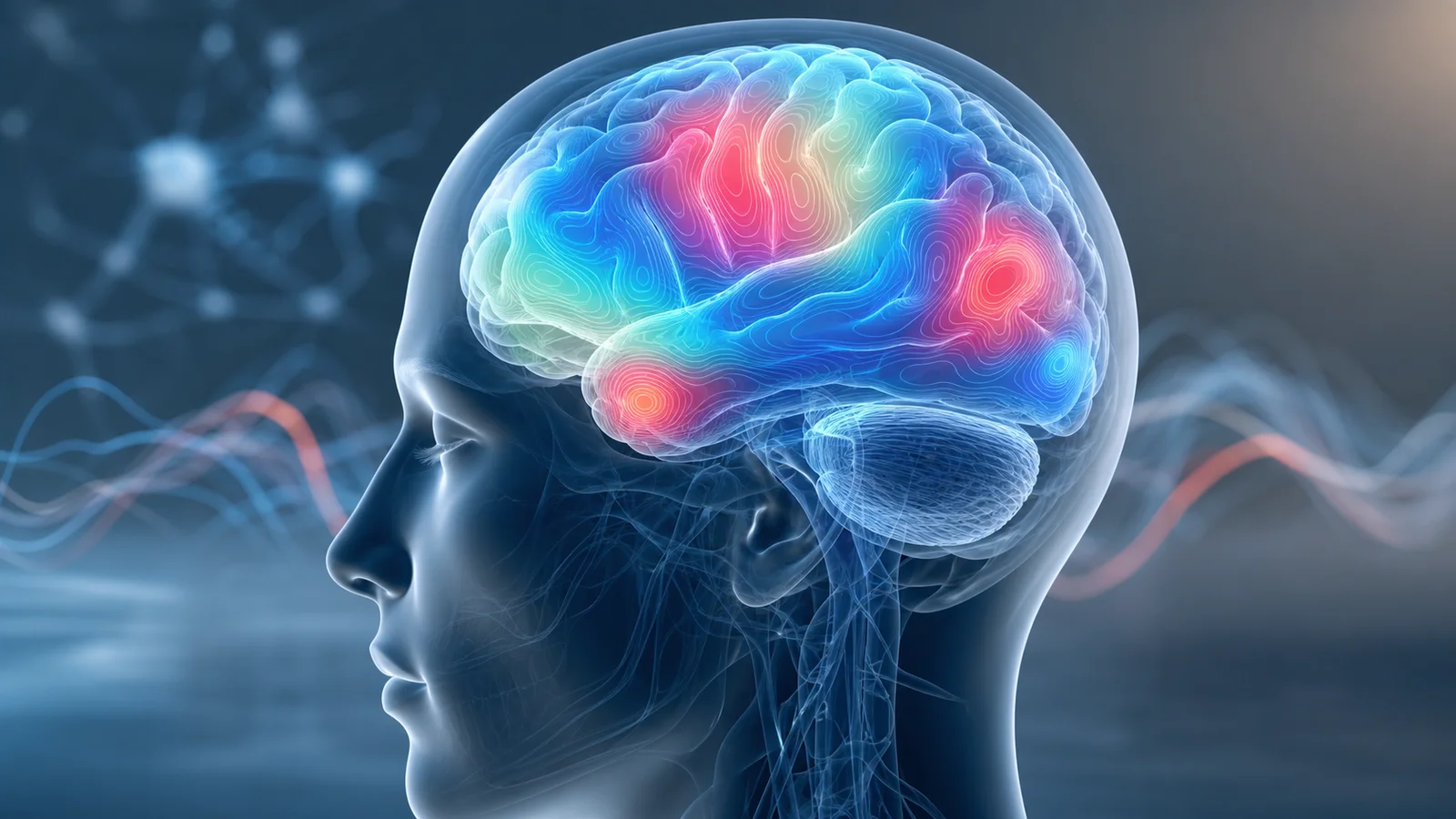
A qEEG (quantitative EEG) brain map records your brain's electrical activity and turns it into a color-coded, 3D map showing how regions communicate and which patterns are over- or under-active. On its own it doesn't label a condition, think of it as a high-resolution picture that lets our trained team identify the patterns behind focus, sleep, worry, or attention, and decide where neurofeedback can help. The difference is depth: we use a 19-channel 3D qEEG read across many layers, connectivity, network signals, and biomarkers across 19 regions at once, not a single snapshot. That 3D map becomes the blueprint for a personalized program, and the baseline we measure your progress against.
What the 3D map actually reads, the many layers
A simple read just looks at how fast or slow a few areas are firing. A multi-layer read goes further: which regions are over- or under-connected, how whole networks coordinate, and where biomarkers cluster. Those layers are where the real story usually lives, and what a basic map skips.
Why overlapping patterns need depth
Most people don't have one clean issue. The same brain can run over-aroused, impulsive, and low-mood at once, across different regions. A single-snapshot brain map, or an over-the-counter headband you run yourself at home, tends to miss that overlap and apply a one-size-fits-all protocol. Our power is specificity: the 3D map shows your unique pattern, and the targeted neurofeedback is matched to it, then adjusted as the 3D map changes. From there we draw on more than 20 different forms of neurofeedback, matched to what your 3D map shows.
Simple metaphor: it's like a topographic map before a hike, it doesn't walk the trail for you, but it shows the terrain so you choose the smartest route. (Intentional oversimplification, brain activity is dynamic, not a fixed landscape, and the 3D map is one input our trained team interprets, not a verdict. See references.)
What a 3D qEEG is, and isn't
It's an assessment tool that maps patterns. It's not, by itself, a medical label or a stand-alone answer; our trained team interprets it alongside your history and goals. We're brain trainers, we map, train, and measure.
What "evidence-informed" means here
The map combines three things: published research on brainwave patterns, our trainers' judgment across 2,000+ 3D brain maps, and your own goals. That's how a personalized blueprint becomes a program you can actually measure.
Frequently Asked Questions
How much does a qEEG brain map cost?
At Vital Brain Health a comprehensive 19-channel 3D qEEG brain map is approximately $850, and it becomes the foundation for any personalized program. Because the same map serves as your baseline, you can measure progress against it over time.
Does a qEEG brain map hurt, and how long does it take?
Not at all. Sensors sit on the scalp and only read activity, so nothing is sent into your brain. The session is comfortable and typically takes about an hour.
Can a qEEG brain map be done remotely?
Yes. We offer remote options so clients across the country can begin with the same research-grade assessment we use in our Pasadena office. The map still becomes the blueprint for a personalized program.
What does a 19-channel 3D qEEG show that a basic brain map does not?
A basic read mostly looks at how fast or slow a few areas are firing. A 19-channel 3D read adds many layers at once: which regions are over- or under-connected, how whole networks coordinate, and where biomarkers cluster across 19 regions. Those deeper layers are where overlapping patterns usually show up.
Does a qEEG brain map diagnose a condition?
No. On its own a 3D qEEG is an assessment tool that maps patterns, not a medical label or a stand-alone answer. Our trained team interprets the map alongside your history and goals, then decides where neurofeedback can help.
References
"From Aberrant Brainwaves to Altered Plasticity: A Review of QEEG Biomarkers and Neurofeedback in the Neurobiological Landscape of ADHD," PMC (2025).
"To spindle or not to spindle: A replication study into spindling excessive beta as a transdiagnostic EEG feature associated with impulse control," PubMed (2021).
"EEG neurofeedback treatments in children with ADHD: an updated meta-analysis of randomized controlled trials," Frontiers in Human Neuroscience (2014).
"Electroencephalogram (EEG)," Cleveland Clinic.
Ready to take the next step?
Talk with the Vital Brain Health team about a Brain Mapping (qEEG) plan built around your brain and your goals.